
Table of Contents
ToggleSolar systems are still out of reach for many Nigerians, and with the poor supply of electricity, they are fast becoming a necessity.
There are several solar financing solutions available in Nigeria for both residential and commercial use.
In this guide, you will find different solar financing options, how to qualify, the risks involved, and the best brands offering flexible plans in Nigeria.
Key takeaways
- Solar financing makes it possible to install a solar system without paying the full cost up front.
- Solar financing options available in Nigeria include bank loans, instalment plans, cooperative loans, leasing, and employer-facilitated plans.
- Key qualifications for solar loans include collateral, valid documentation, a guarantor, and sometimes a down payment of 20–30%.
- The Hire Purchase Act (Cap H4, LFN 2004) protects you in any instalment or lease-to-own arrangement, ensuring your provider complies.
What is solar financing?
Solar financing refers to the various ways individuals, businesses, or organizations can pay for a solar power system without bearing the full upfront cost at once.
Solar power systems can be expensive at the point of installation, but solar financing lets you get your desired system without paying up front.
How does solar financing work?
Solar financing in Nigeria works by breaking down the payment period for your solar; you don’t have to pay for everything at once, you can pay for it monthly, quarterly, or as agreed with your provider.
Once payment is complete, the solar system will be fully yours.
In most cases, immediately after your first payment, the solar system is installed for you to start using it before payment is complete.
Solar financing in Nigeria can also cover Solar generator financing, Solar equipment financing, solar maintenance fees, and all other components of the solar system.
Solar financing models in Nigeria
The solar financing options available in Nigeria are solar loans, lease, pay-as-you-go(PAYG), and Solar Installment Plans from Solar Companies:
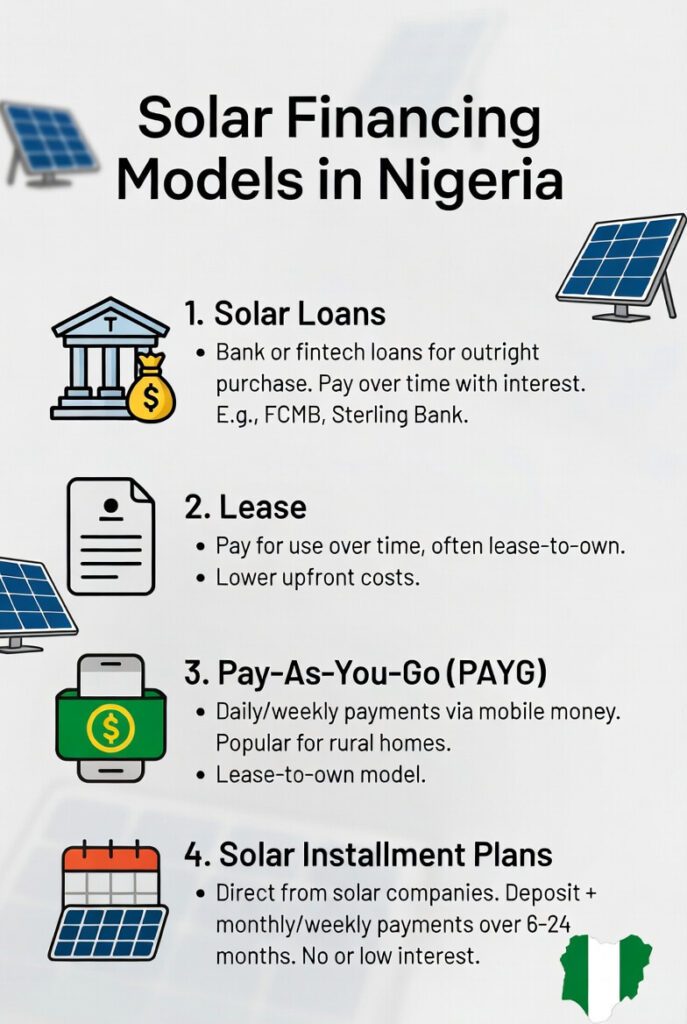
- Solar loans: You can get loans to finance your solar installation from third parties like banks, employers, and cooperatives.
- Lease: Here, you pay a certain amount to the solar owner to use the system for a period of time; this payment usually includes maintenance fees.
- Pay-as-you-go(PAYG): This model allows people to get solar without a large upfront payment. You receive a solar system and pay for it in small, regular instalments, daily, weekly, or monthly, and your payments are linked directly to your access to the system.
- Solar installment plans from solar companies: Some solar companies in Nigeria allow Solar installation on an installment plan, where you pay for the solar system in monthly payments.
This calculator will tell you the exact solar system you need.
Solar Financing Options in Nigeria
Solar financing options, or Solar funding options, in Nigeria can take the form of bank loans, installment payments, cooperative societies, solar leasing, employer-facilitated loans, and group or personal savings.
Solar financing options exist for both residential and commercial users.
Residential solar financing options
- Bank loans for individuals: Some banks, WEMA Bank, and Sterling now offer dedicated, long-term financing for renewable energy solutions covering up to 80% of costs.
- Installment payment: Some providers of solar systems allow weekly or monthly installment payment for the period agreed upon after the upfront payment has been made.
- Outright purchase: This is for households that can afford the full cost upfront. You own the system immediately, avoid interest payments, and start saving on energy costs from day one.
- Cooperative societies: Local cooperative societies are another route worth exploring. Their loan terms tend to be simpler and more flexible than those of traditional banks.
- Solar leasing for residential use: Companies like JMG Limited offer flexible leasing solutions for medium and large-scale solar systems. They let you simply pay for the electricity you consume with no ownership required, often with a maintenance fee included.
- Employer-facilitated Loans: Some companies partner with solar providers to offer staff solar systems deducted directly from salary.
- Group/Personal saving: Many Nigerians who cannot afford to finance a solar system at once save individually or as a group towards their goal.
- Power Purchase Agreement (PPA): A landlord can install a solar system on their property and charge tenants for the electricity they consume, usually at a rate lower than generator costs.
Commercial solar financing options
- Commercial solar loans: Banks like FCMB and Fidelity Bank are offering solar loans to registered businesses.
- Solar leasing for businesses: With a solar lease, the customer rents the solar system from a provider for a fixed period, with maintenance often included, or you can choose Lease-to-Own and pay monthly while working toward full ownership at maturity.
- Solar energy providers for business: Companies like Daystar Power offer subscription-based models where businesses pay per kilowatt-hour of solar energy consumed with no upfront cost. You are not buying the solar system here but rather paying for the kilowatt you consume.
- Power Purchase Agreement (PPA) at business location: This model is also common among plaza and commercial property owners in Nigeria. The landlord or property owner finances and installs a solar system, then sells electricity directly to business occupants at an agreed rate per kilowatt-hour.
Qualifications required for a solar loan in Nigeria
The qualifications required to access a solar loan in Nigeria include ;
- Collateral: In some cases, collateral like Land or property documents, vehicle particulars, and existing equipment or machinery (for businesses) is needed.
- Registered Business: To be eligible for loans like the FCMB solar energy loan, your business must be properly registered.
- Documentation: Documents like your NIN, BVN, and payment slip might be required.
- Guarantor: Some companies require at least one or two guarantor and their valid ID cards.
- Down payment: Some financers require you to make a down payment of 20-30%.
What to look out for when applying for solar loans
- Solar loan interest rates: A very high interest rate can inflate the total cost. When the total cost is high, it can lead to default.
- Solar loan terms: Unrealistic short-term payment is a red flag and can also lead to default.
- Hidden fees: Avoid Solar financing options that do not have a transparent breakdown of costs.
- Vendor’s reputation: Check for reviews on their solar loan option and decide if it’s worth getting.
- Hire-Purchase Act (Cap H4, LFN 2004): Ensure that your loan financing option abides by the Hire Purchase Act, which governs installment sales for goods, mandates clear terms on payments, ownership (transfers post-final payment), and warranties.
Top Solar Financing Companies in Nigeria
Some of the top companies that provide financing for solar projects include;
- Arnergy
- FCMB
- WEMA Bank
- Sterling Bank
- JMG Limited
- Wisolar
- Daystar Power
- Rivy
- FundQuest
- Astrum Energy
Frequently Asked Questions
Yes, with an installment payment plan, you can pay monthly for your solar panels.
Yes, different financing options are available for solar panel purchases.
Yes they are certain criteria you need to meet before getting a loan.
Yes, several solar finance solutions like loans, installment payments, and leases are available in Nigeria.
Conclusion
The electricity supply in Nigeria has not improved for years. It is advisable to take advantage of available solar financing options and install your solar panels today.
Whether you go through a bank loan, a cooperative, or a lease plan, there is an option that fits your income and lifestyle. The most important step is understanding the terms, confirming the lender is reputable, and ensuring your agreement complies with the Hire Purchase Act before signing anything.
Start by comparing the financing options listed in this guide and reaching out to a trusted solar provider near you.
We will tell you how much your intended solar system would cost for free.
