
Table of Contents
ToggleImagine cutting your electricity bills, powering your home or business without interruption, and never experiencing another blackout again.
In this guide, you will find out why solar is worth it in Nigeria, what appliances solar can power, the pros and cons, and how solar compares to fuel generators, so you can make the best decision for your home or business.
Key takeaways
- Solar is still worth it in Nigeria in 2026 because it eliminates the high recurring cost of fueling a generator and gives you a stable, uninterrupted power supply.
- The size of your solar system determines what appliances it can power, ranging from basic lighting with a small system to AC units and heavy appliances with a 6kW system and above.
- When compared to a generator, a solar system has a higher upfront cost but is cheaper in terms of running costs, maintenance, lifespan, noise, and environmental impact.
- Despite the high upfront cost, solar is a long-term investment that pays for itself over time while increasing the value of your property.
Why is solar worth it to Nigerians?
Solar is still worth it to Nigerians because it provides a stable power supply, helps you beat high electricity costs, has a positive environmental impact, increases your property value, is cheaper than generator alternatives, and requires low maintenance.
- Stable power supply: Once you get a solar system, you can always count on having a stable electricity supply, without always relying on Nepa.
- Cheaper electricity cost: Generating your own electricity using a solar system is cheaper than paying for government-supplied electricity or generator electricity.
- Environmental impact: Solar is a clean way of generating energy, reducing carbon emissions in the environment.
- Higher property value: Properties with solar systems always command a higher value in the market; people will always prefer to buy or rent properties with constant energy from solar.
- Easy to maintain: Solar systems require less maintenance than fuel generators.
NOTE:
There are several ways you can finance your solar system without having to pay for it at once. You can learn about solar financing in Nigeria; there are many options you can pick from, such as bank loans, installment payment plans, and even leasing options.
What are the appliances can solar systems power?
There is a wrong assumption among Nigerians that solar systems cannot power big appliances; well, that is not true.
What is true is that the size of the appliances your solar system can carry depends on the wattage of your solar panel.
Here is a breakdown of the type of appliances each watt of solar panel can carry:
Solar system size | Appliances it can carry |
250kW – 400kW (Single Panel) | Phone chargers, LED bulbs, a small fan, and a radio. |
1kW – 2kW System | LED lighting, phone charging, a small TV, laptops, a power bank, and a ceiling fan. (Not suitable for fridges or AC). |
3kW – 5kW System | LED lights, ceiling fans, a medium TV, a refrigerator, and a small freezer. Still struggles with AC units. |
6kW – 10kW | Powers everything in the 5kW range, plus one or two 1.5HP air conditioners, a pumping machine, and a washing machine. |
10kW – 20kW System | Powers multiple AC units, industrial freezers, office equipment, and heavy appliances simultaneously. ( for large homes and small-to-medium businesses.) |
20kW and above | Factories, machines, plazas, hospitals, and large offices. (for commercial and industrial use) |
Solar vs. generator, which one is worth getting
Some people are still confuse on weather to get a solar system or a generator.
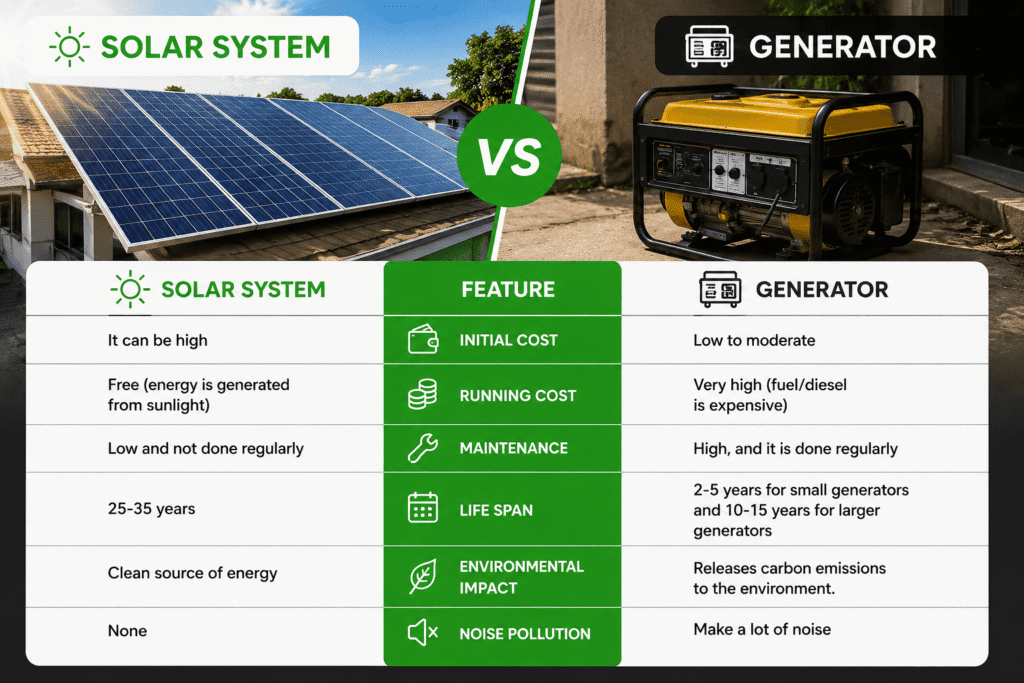
Here is a table that shows you clearly the different features between the two to help you make a wise decision:
Feature | Solar system | Generator |
Initial cost | It can be high | Low to moderate |
Running cost | Free (energy is generated from sunlight) | Very high (fuel/diesel is expensive) |
Maintenance | Low and not done regularly | High, and it is done regularly |
Life span | 25-35 years | 2-5years for small generators and 10-15 years for larger generators |
Environmental impact | Clean source of energy | Releases carbon emissions to the environment. |
Noise pollution | None | Make a lot of noise |
We will tell you how much your intended solar system would cost for free.
Advantages and disadvantages of a solar system
There are both advantages and disadvantages of a solar system
Advantages of a solar system
The advantages of solar include:
- Reduces electricity bills: Once you install your own solar, you can generate your own power and significantly cut or eliminate electricity expenses.
- Low running cost: Sunlight is free. Unlike generators, there is no recurring fuel expense.
- Low maintenance: Solar panels require very little servicing compared to generators or other power alternatives.
- Long lifespan: Quality solar panels can last 25 years or more, making it a long-term investment.
- Stable power supply: No dependence on NEPA or fuel availability. You control your own electricity.
- Environmentally friendly: Solar generates clean energy with zero carbon emissions, which is one of the many advantages of renewable energy
- Increases property value: Homes and buildings with solar systems attract higher market value and are more appealing to buyers and tenants.
Disadvantages of a solar system
The disadvantages of a solar system include:
- High initial cost: The cost of buying the solar panels and installing them can be high.
- Roof damage: If not installed properly, the panels can cause damage to the roof of your building.
- Weather-dependent: solar panels generate power from the sun, it can struggle during cloudy days.
- Battery limitations: Without a strong battery bank, the power supply at night can be insufficient, and you still need a charge controller to protect the battery.
- Require space: Adequate roof or ground space is needed for panel installation.
Frequently Asked Questions
Yes, you can run an AC with a 6kW – 10kW solar panel and above.
The biggest downside is that it is heavily dependent on the weather, as sunlight is the source of power.
The most reputable solar company in Nigeria is Solarlify.
Conclusion
The question is not whether solar installation is worth it in Nigeria; the question is how long you can afford to live without constant electricity.
Between NEPA’s unreliable supply, rising electricity tariffs, and the punishing cost of fueling a generator every day, we can all agree that solar is worth it.
Whether you are a homeowner tired of blackouts or a business owner watching fuel costs eat into your profits, solar is no longer a luxury; it is the smarter, cheaper, and cleaner long-term choice you should have.
