
Table of Contents
ToggleTo get the most out of your solar panels without losing any generated power, you need an MPPT charge controller.
The Maximum Power Point Tracking (MPPT) charge controller tracks and extracts the maximum power from your panels into a usable battery charge.
In this guide, you will discover what an MPPT charge controller is, why it is efficient, its benefits, and how to choose the right one for your solar system.
Key takeaways
- An MPPT charge controller extracts the maximum available power from your solar panels at any given moment, regardless of weather or temperature.
- MPPT technology continuously adjusts voltage and current in real time to keep your panels operating at their peak output.
- Compared to PWM controllers, MPPT can harvest up to 25% more energy, making it the smarter long-term investment.
- MPPT controllers charge your battery faster, protect it from damage, and extend its overall lifespan.
- To choose the right MPPT controller, calculate your total panel wattage, match your battery voltage, and apply the charging current formula with a 25% safety margin.
What is a charge controller?
A solar charge controller is an electronic device that regulates the current and voltage flowing from your solar panels into your batteries and electrical loads. A charge controller also protects the battery from damage while delivering the right current and voltage.
What is Maximum Power Point Tracking?
Maximum power point tracking, or MPPT, is a technology built into modern MPPT charge controllers to help solar systems operate at their best.
Solar panels don’t always produce the same amount of power. Their output changes constantly depending on sunlight intensity, temperature, and shading.
MPPT technology works by continuously monitoring your solar panel’s output and adjusting the voltage to find the point where the panels produce the most power at any given moment. That point is called the Maximum Power Point.
What Is An MPPT Charge Controller?
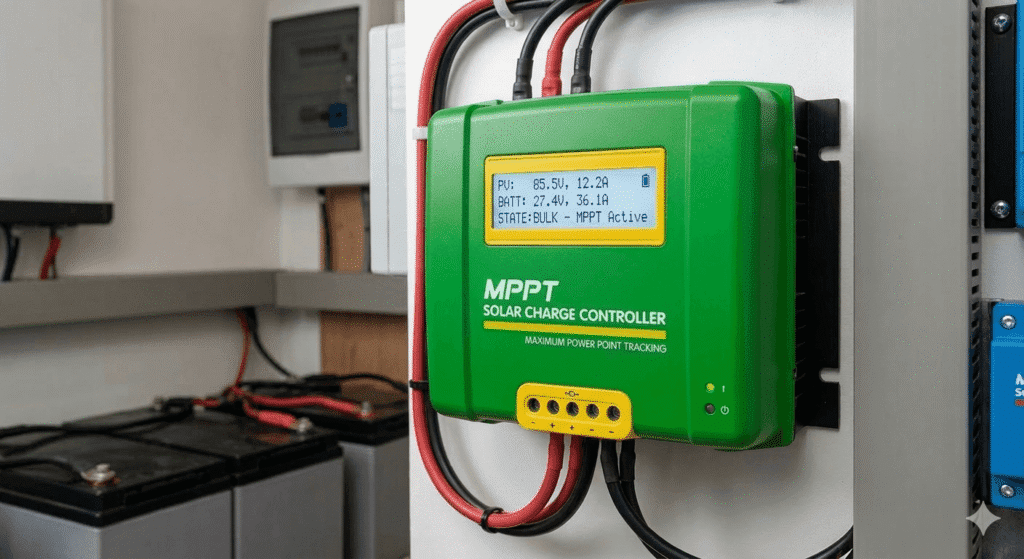
MPPT (Maximum Power Point Tracking) is the more advanced and intelligent type of solar charge controller.
It continuously monitors and adjusts the voltage and current coming from the solar panel to ensure it is always operating at its peak power output, regardless of weather or temperature changes.
According to Electrical technology, MPPT can harvest up to 25% more energy than PWM.” This makes MPPT the preferred choice for larger, more demanding solar installations such as residential or commercial systems.
MPPT charge controller common applications
- Large residential solar systems
- Commercial and industrial solar installations
- Off-grid homes with high energy demands
- Solar-powered electric vehicle charging stations
- Large agricultural solar setups
- Remote telecommunications towers
- Solar-powered hospitals and schools
- Large-scale water pumping systems
How MPPT Charge Controllers Work
The core job of an MPPT charge controller is to make sure your solar panel always operates at the voltage where it produces the most power.
It does this in three simple steps:
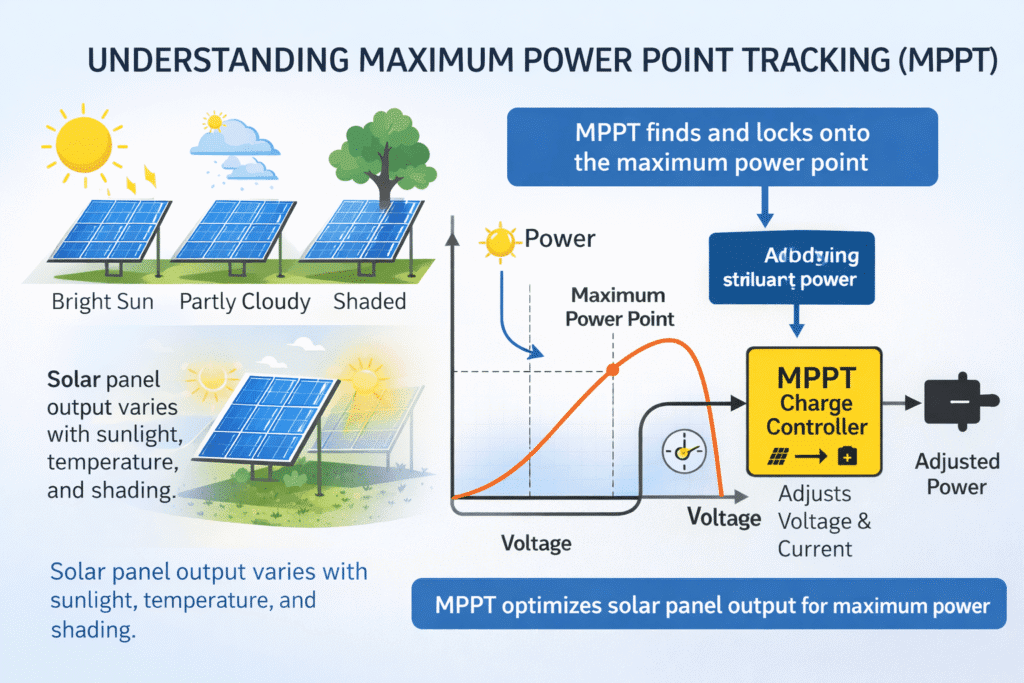
- First, it reads the output coming from your solar panel.
- Then it checks your battery’s current voltage.
- Finally, it adjusts the panel to operate at its most efficient point and converts whatever power is available into the best possible charging current for your battery.
Benefits of an MPPT Charge Controller
The benefits of using an MPPT solar charge controller include;
- Maximum energy harvest: An MPPT charge controller can harvest up to 25% more energy than a regular charge controller.
- Unfavourable weather performance: An mmpt charge controller can generate energy when sunlight is weak, on cloudy days, and late evenings.
- Faster battery charging: An MPPT charger controller pushes more energy into your battery in less time. By converting excess panel voltage into additional charging current.
- Longer battery lifespan: MPPT controllers regulate charging with precision, avoiding overcharging and undercharging that can damage your battery.
- Works with higher voltage panels: MPPT controllers are compatible with higher voltage solar panels, giving you more flexibility when designing or expanding your solar system.
How to pick the right MPPT charge controller
- Total Solar Panel Power: Add up the wattage of all your solar panels. Your MPPT controller’s rated power must be equal to or greater than that total.
- Battery Voltage: Match your controller to your battery system voltage. These must be compatible for the system to work correctly.
- Current Rating Use this simple formula: Charging current = (Total panel wattage ÷ Battery voltage) × 1.25 to choose the right charge controller. (to understand charging current better ).
- Maximum Input Voltage: Make sure your controller’s maximum input voltage is higher than your panels’ open circuit voltage (Voc), with at least a 20% margin for safety.
Frequently Asked Questions
Yes, it helps you get efficient energy even with low sunlight without wastage.
You can buy MPPT from online stores like Jumai or physical stores in the market.
An MPPT charge controller in Nigeria costs between ₦15,000 and ₦300,000.
Conclusion
An MPPT charge controller produces energy even with low sunlight. It ensures that every watt your panels produce reaches your battery.
Whether you are powering a residential or commercial building, an MPPT can be very useful. The right controller does not have to be complicated to find.
Start by understanding the cost of a charge controller. Read it here.
