
Table of Contents
ToggleSetting up a solar system isn’t just about buying panels and batteries; other components, like the charge controller, play a vital role.
Without it, your batteries could overcharge, overheat, or fail within months.
In this guide, you will understand what charger controllers are, how they work, the different types available in Nigeria, and the several benefits of a solar charge controller.
Key takeaways
- A charge controller is a regulatory device that manages the flow of electricity between your energy source and battery, protecting it from overcharging and over-discharging.
- There are two main types of solar charge controllers: PWM for small, budget-friendly systems and MPPT for larger systems that require maximum efficiency.
- Choosing the right charge controller requires matching the correct amperage, voltage, and battery type to your specific solar system.
- For lithium batteries, MPPT charge controllers are the best option due to their precise voltage control and customizable charging profiles.
- A charge controller is not exclusive to solar systems; it is also used in wind and hybrid energy systems to regulate and protect battery banks.
What is a charger controller?
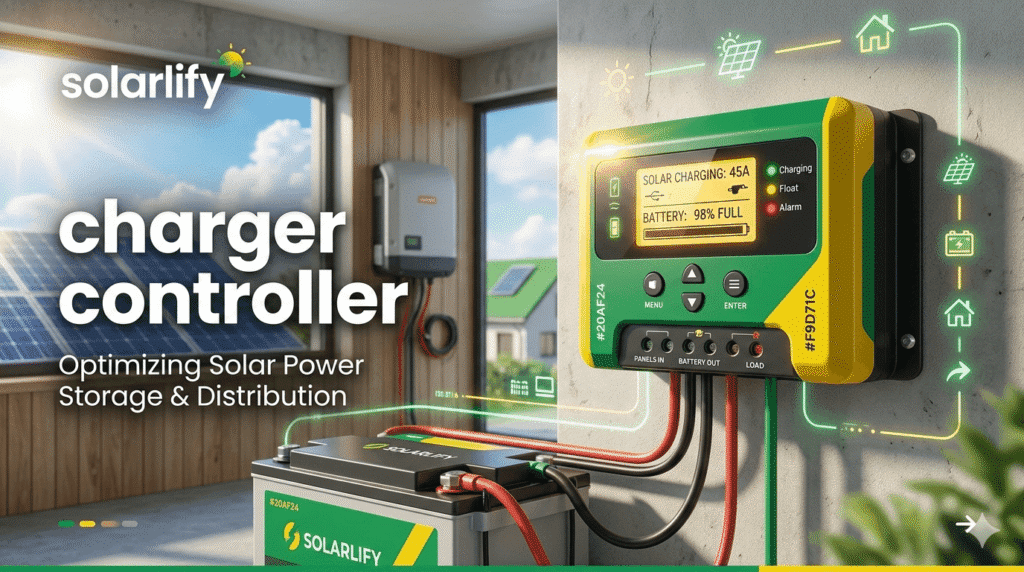
A charger controller is a regulatory device that manages the flow of electricity between your energy source and your battery.
Its primary job is to make sure your battery charges properly without getting damaged from overcharging or over-discharging.
A charger controller also regulates the voltage and current going to connected electrical loads.
Charger controllers are not exclusive to solar systems. They are used across various renewable energy setups, including wind and hybrid systems.
How does a charge controller work
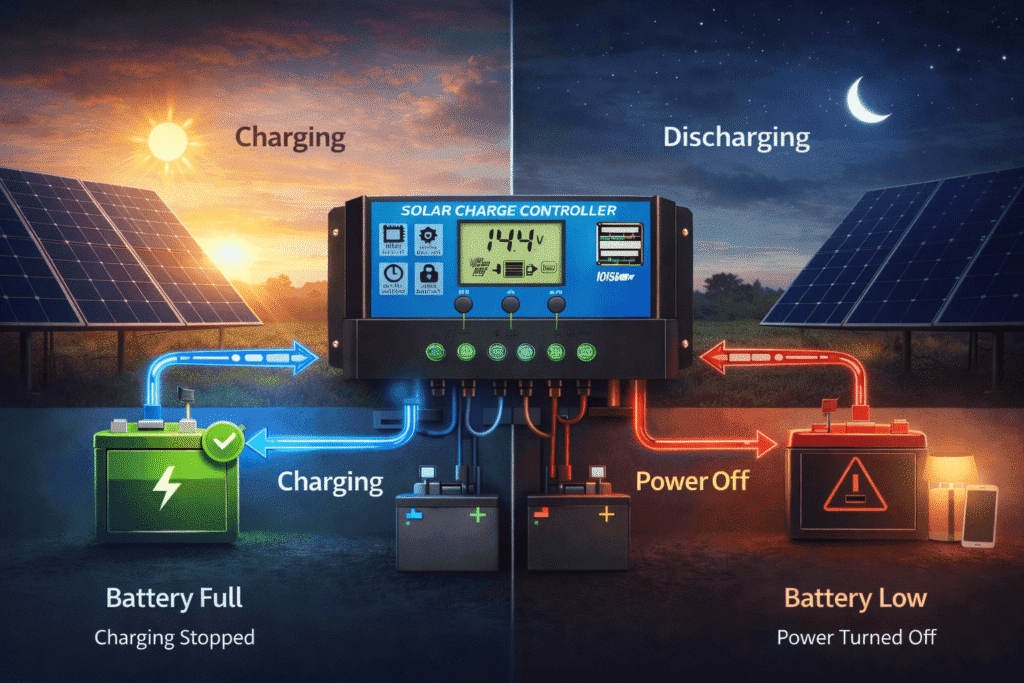
Imagine a charge controller as a smart switch between your solar panels and your batteries. It has two main switches working automatically.
The first switch controls charging. When the solar panels generate power, it allows the electricity to flow into the battery. Once the battery is full, it cuts off power to avoid damage.
The second switch controls discharging at night or when there is no sunlight, allowing the battery to supply power to your devices.
Also, most charge controllers contain low-voltage protection. When the battery drops too low, the charge controller turns off power to protect it and restores power immediately when the battery is charged.
What is a solar charge controller?
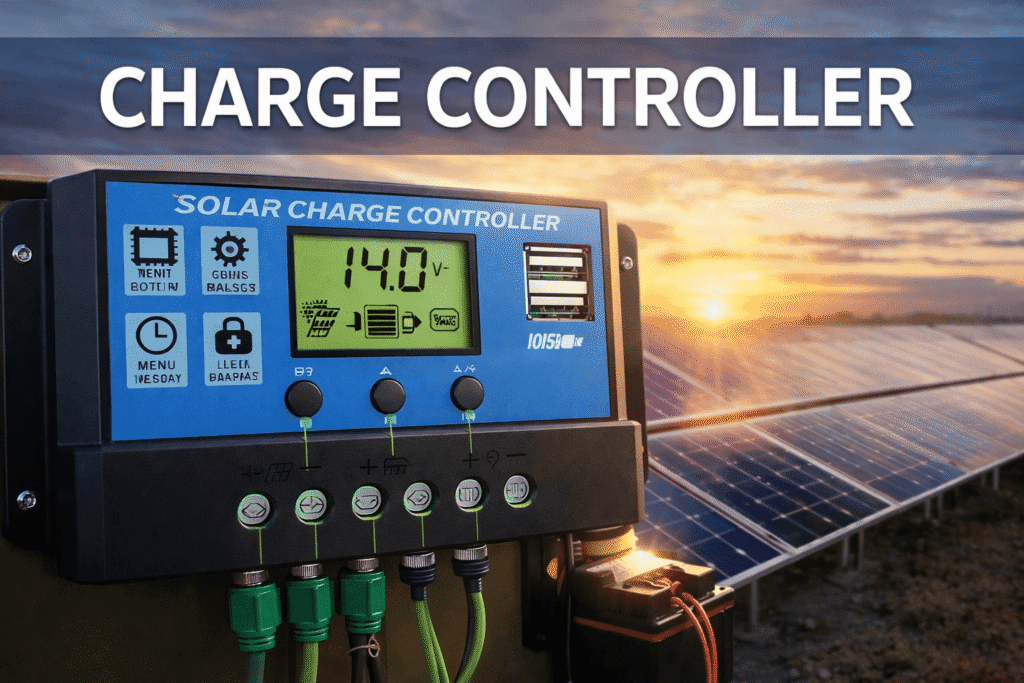
A solar charge controller is an electronic device that regulates current and voltage from your solar panels. It controls the flow of power into your batteries and electrical loads, including lights, fans, cameras, and telecom equipment.
Solar charge controllers are used to maintain batteries at their highest state of charge without overcharging them to avoid battery damage and overheating.
This helps to prolong battery life. Charge controllers also deliver proper current and voltage that meet the rated capacity of electrical loads.
Key benefits of a solar panel charge controller
The major benefits of a solar charge controller include;
- Battery Protection: A solar panel charge controller prevents your battery from overcharging and over-discharging, which are the two main causes of battery damage.
- Prevent Current Reverse: At night or when there is no sunlight, solar panels do not produce power; during this period, there is a risk of current flowing backwards from the battery into the panels. The charge controller acts as a gatekeeper, stopping this reverse.
- Controls Power to Connected Loads: Beyond just charging batteries, a solar panel charge controller manages how power is distributed to connected devices, ensuring every load receives the right amount of power it needs.
- Extends the Life of Your Entire System: By reducing unnecessary stress on both batteries and panels, a charge controller helps every component in your solar system last longer.
- Adaptability to Environmental Changes: Cloudy weather conditions or shade can affect the impact of your solar panels. But the MPPT charge controllers are designed to adapt to these changes, delivering high efficiency.
What are the types of charge controllers?
There are two charge controller types: the PWM Charge Controllers and the MPPT Charge Controllers.
What are PWM Charge Controllers?
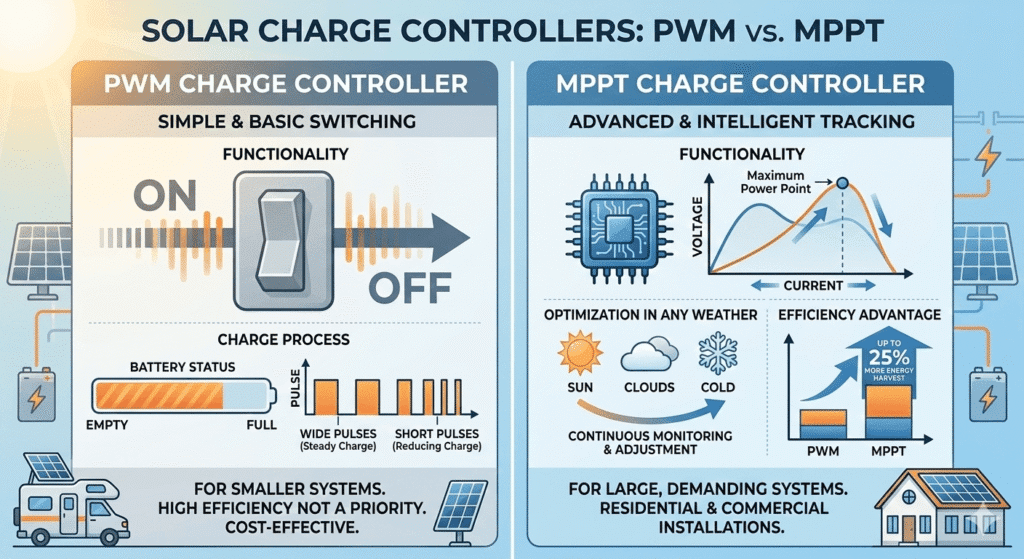
PMW is the simpler type of solar charge controller. It charges a battery by rapidly switching power on and off between the solar panel and the battery.
As the battery fills up, the pulses get shorter until charging stops completely.
What are MPPT Charge Controllers?
MPPT (Maximum Power Point Tracking) is an advanced type of solar charge controller.
It continuously monitors and adjusts the voltage and current coming from the solar panel to ensure it is always operating at its peak power output, regardless of weather or temperature changes.
Difference between an MPPT solar charge controller and a PWM solar charge controller
Features | PWM | MPPT |
How they work | Switches power on and off to control the charge | Continuously adjusts voltage and current for maximum power output |
Efficiency | Less efficient | Up to 25% more efficient than PWM |
Cost | Cheaper and budget-friendly | More expensive |
Best For | Small systems like solar lights, camping, and RVs | Large systems like residential or commercial installations |
Voltage Compatibility | Panel voltage must match battery voltage | Works even when panel and battery voltages don’t match |
Weather Performance | Performs poorly in cloudy or low-light conditions | Adjusts automatically to maximize output in any weather |
Charge controller for a wind turbine
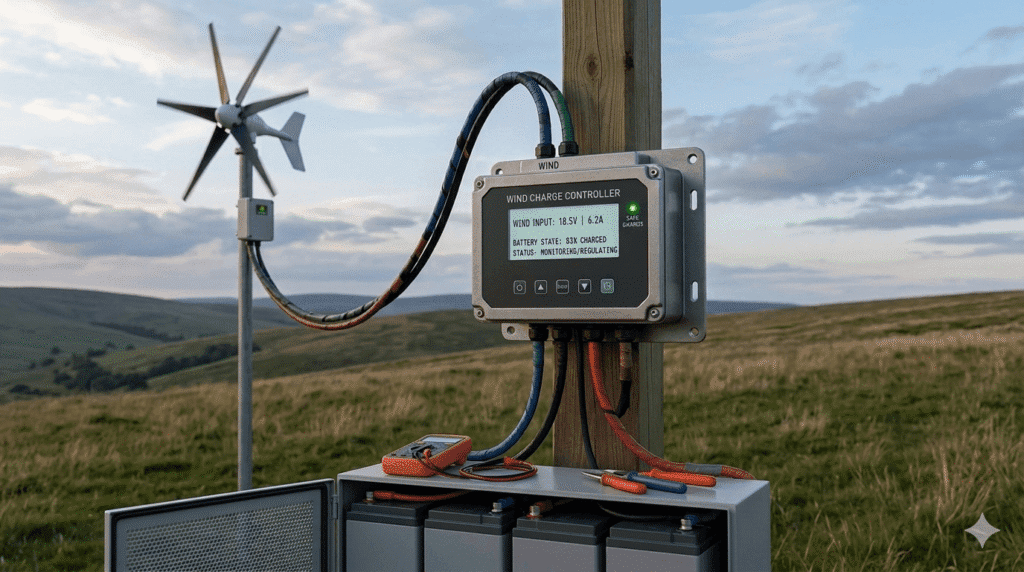
Similar to the way a solar charge controller manages power, a charge controller for wind turbines regulates the electricity generated by the turbines flowing into the batteries.
Also, direct it to charge batteries safely and protect those batteries from overcharging.
It continuously monitors voltage and current to ensure the charging process is safe and efficient at all times.
How to choose the right solar charge controller
Picking the right solar charge controller is crucial for excellent performance. Here are key factors to consider.
- Calculate the amperage you need: The first thing to figure out is how many amps your charge controller needs to handle. You need to understand how to conduct a proper charge control sizing first.
- Battery type and voltage: Your charge controller must match your battery bank voltage, typically. For example, a solar charger controller 12V works with a 12V battery system. A mismatch can cause battery damage.
- Decide between a PWM or MPPT: Choose PWM for small, budget-friendly systems where your panel and battery voltage are closely matched, and choose MPPT for larger systems where maximum efficiency and energy harvest matter most.
What is the best charge controller for a lithium battery
For lithium batteries like LiFePO4, MPPT charge controllers are best because of their high efficiency, precise voltage control, and customizable charging profiles.
The characteristics of the MPPT charge controller match lithium’s needs, preventing overcharge or damage.
Frequently asked questions
Yes, you need a charge controller. It protects your battery and helps it last longer.
It regulates current and voltage from your solar panel. It controls the flow of power into your batteries and maintains batteries at their highest state of charge without overcharging them.
Using solar panels without a charge controller increases battery damage risk, reverse current flow, shortens battery life, and results in an inefficient power supply.
Yes, a charge controller and an inverter can be in one piece of equipment. This is known as an all-in-one inverter or a hybrid inverter.
Conclusion
A solar power system consists of different components, including the charge controller, which protects the battery, optimizes energy, extends the system’s lifespan, and increases performance.
Choosing between PWM and MPPT comes down to your system size, budget, and needs.
Start by understanding the cost of a charge controller. Read it here.
