
Table of Contents
ToggleYour solar battery is dying faster than its original life span, which could be related to your charge controller.
The PWM charge controller is the most common and affordable charge controller in Nigeria that protects your battery from damage and extends its lifespan.
In this guide, you will learn what a PWM charge controller is, how it works, its benefits, and how to pick the right one.
Key takeaways
- PWM charge controllers are the most affordable and common charge controllers in Nigeria.
- The PWM charge controller protects your battery from overcharging, overheating, and sulfation.
- The PWM charge controller extends battery lifespan by 20-30% through controlled pulsing.
- PWM charge controllers require minimal maintenance due to their simple design.
- A PWM charge controller works best for small solar systems below 400W, and is not ideal for large solar systems where high efficiency is a priority.
What is a charge controller?
A solar charge controller is an electronic device that regulates the current and voltage flowing from your solar panels into your batteries and electrical loads. A charge controller also protects the battery from damage while delivering the right current and voltage.
What is PWM?
Pulse Width Modulation (PWM) is a technique used in electronics to control the power supplied to electrical devices by changing the width of pulses in a periodic signal.
PWM rapidly switches a signal ON and OFF, typically at frequencies of 30-300 Hz.
What is a PWM Charge Controller?
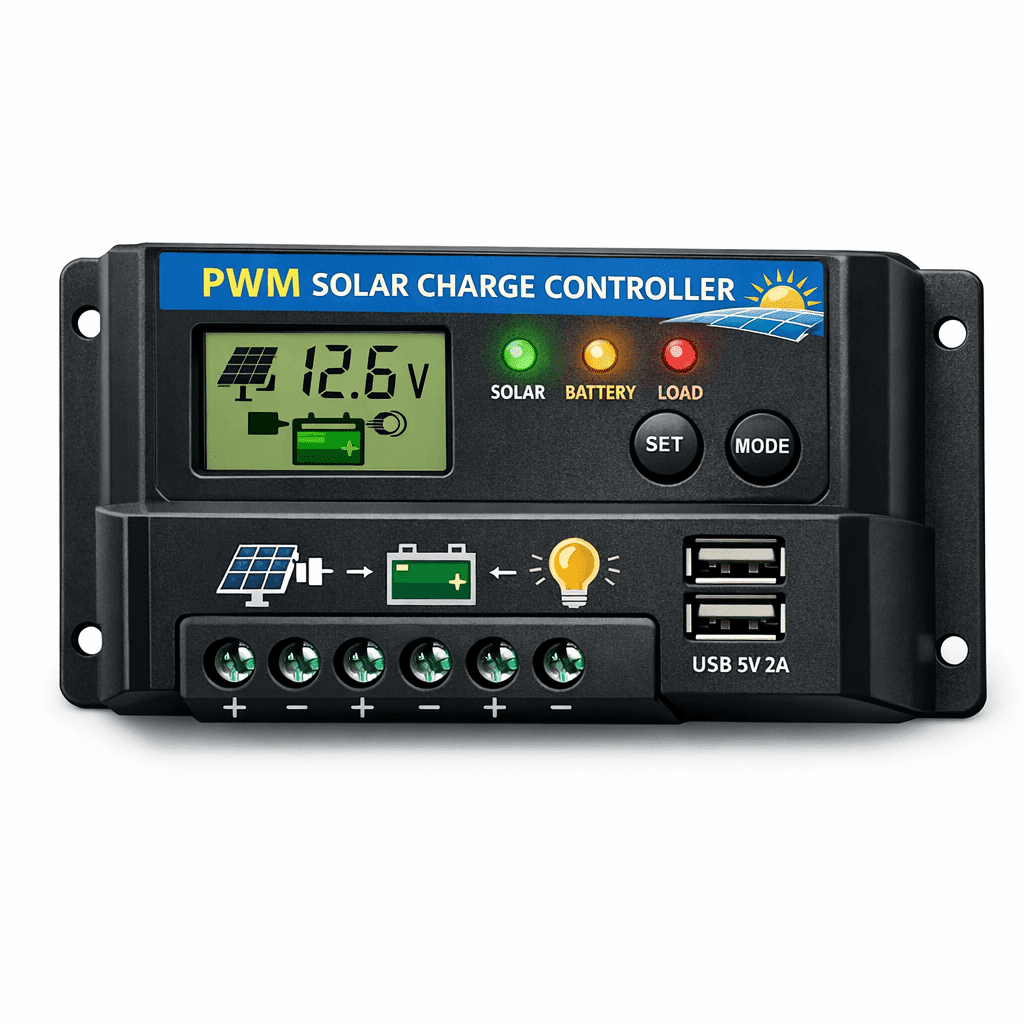
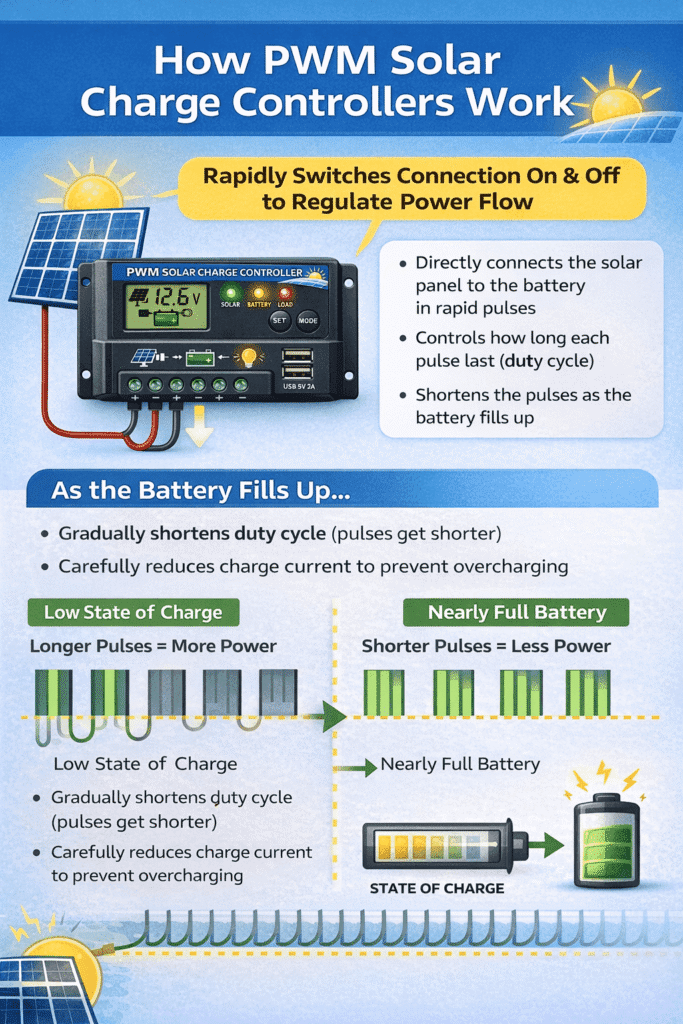
A PWM (Pulse Width Modulation) solar charge controller works by rapidly switching the connection between the solar panel and battery on and off to deliver a controlled and steady charge.
As the battery gets fuller, the pulses become shorter, gradually reducing the charge until the battery is full.
It is a straightforward technology that is cost-effective and easy to maintain. However, it is best suited for smaller solar systems where high efficiency is not a priority.
Common applications for a PWM charge controller
- Small home solar systems
- Solar-powered street lights
- Small cabins or rural homes with basic power needs
- Camping and outdoor solar setups
- Solar-powered water pumps in small farms
- Small telecommunications equipment
- Basic security camera systems
- Solar garden lights
How PMW Charge Controllers Work
A PWM charge controller regulates the flow of power from a solar panel to a battery by switching the connection on and off.
During each pulse, the controller connects the solar panel directly to the battery, allowing current to flow and charge the battery.
Instead of reducing the voltage electronically, the controller controls how long the connection stays on during each cycle. This is known as the duty cycle.
As the battery fills up, the controller gradually reduces the duty cycle, meaning the pulses become shorter. This slowly decreases the charging current and prevents the battery from overcharging.
Benefits of a PWM Charge Controller
The benefits of a charge controller include;
- Budget-friendly: The PWM is the most affordable charge controller for smaller solar systems.
- Simple Design: The PWM charge controller has minimal wiring; no complex setup is needed.
- Battery longevity: Pulsing reduces gassing, heating, and sulfation, restoring capacity and equalizing cells for 20-30% longer life.
- Battery protection: They consist of components that protect the battery from overcharging and overheating.
- Efficient charging stages: They use pulse-width modulation technology to regulate battery charge levels efficiently, and can even help restore capacity that has been lost over time.
How to pick the right PWM charge controller
- System sizing: Add up the wattage of all your solar panels, preferably below 400W. PWM is best for a smaller budget-friendly system.
- System voltage compatibility: Check your battery system voltage. These must be compatible for the system to work correctly, like a 12V battery system voltage for a 12V PWM charge controller.
- Additional features: Pick a couple of PWM charge controllers and check for additional features like temperature compensation, monitoring capabilities, and load terminals. Ensure it aligns with your charge controller.
- Current rating: Use this simple formula: Charging current = (Total panel wattage ÷ Battery voltage) × 1.25 to choose the right charge controller from the list you already have. (to understand charging current better).
Frequently asked questions
Yes, PWM charge controllers are best for small solar panels.
You can buy a PWM charge controller from online stores like jumia physical stores in the market.
A PMW charge controller in Nigeria costs between ₦6,000 and ₦65,000.
Conclusion
A PWM charge controller is an affordable and reliable option. It keeps your battery safe from overcharging, extends its lifespan, and requires little maintenance.
PMW charge controllers are very accessible in Nigeria.
Start by understanding the cost of a charge controller. Read it here.
