
Table of Contents
ToggleIf you have been experiencing food spoilage and overall loss of money, and want to put an end to it using a solar power freezer. You will need to buy the right solar power freezer at the right price.
In this article, I will break down the components of a solar power freezer system, the Solar fridge price in Nigeria, and share practical tips to save money.
You will also learn the key factors that affect the cost, so you can know how to choose the right solar freezer.
Key Takeaways:
- Solar fridge prices in Nigeria range from ₦389,460 to ₦1,417,293, while solar deep freezer prices range from ₦370,000 to ₦1,850,000, depending on the brand, capacity, and whether panels and batteries are included.
- A solar freezer runs on energy from the sun stored in batteries, so your food stays frozen even when NEPA fails or your generator runs out of fuel.
- For most Nigerian homes, a 100 to 150L solar freezer is enough, while small business owners like provision store operators and drink sellers should go for a 200L unit to save up to ₦60,000 monthly on petrol.
- Always calculate the total cost of getting a solar freezer. This includes panels, battery, charge controller, and installation included before buying.
What is a solar power freezer?
A solar power freezer is a freezer that doesn’t rely on NEPA or a generator to keep your food frozen. Instead, it runs on energy from the sun.
During the day, solar panels capture sunlight and store it in batteries, which then power the freezer even at night or when the power is out.
What is the solar fridge price in Nigeria?
Solar fridge price in Nigeria ranges from ₦389,460 to ₦1,500,000.
Product | Capacity | Price (₦) |
CLOUD BCD 220 Fridge/Freezer (AC) | 220L | ₦389,460 |
CLOUD 220L DC Fridge BCD | 220L | ₦495,253 |
BONA BCD-112L AC/DC Refrigerator | 112L | ₦514,987 |
CLOUD 238L AC Fridge | 238L | ₦603,512 |
SMKSOLAR SMK 108L Bundle | 108L | ₦932,568 |
BONA 202L AC/DC Refrigerator Bundle | 202L | ₦1,113,738 |
SMKSOLAR SMK 168L Bundle | 168L | ₦1,132,781 |
SMKSOLAR SMK 218L Bundle | 218L | ₦1,417,293 |
We will tell you how much your intended solar system would cost for free.
Solar Deep Freezer Prices in Nigeria
A solar deep freezer price in Nigeria can range from ₦450,000 to ₦1,100,000.
Product | Capacity | Price (₦) |
INTEGRITY 120L Freezer | 120L | ₦464,500 |
SMKSOLAR 12/24V AC/DC Solar Freezer | 138L | ₦469,972 |
INTEGRITY 180L Freezer | 180L | ₦499,337 |
BONA 218L/12-24V Freezer | 218L | ₦542,675 |
SMKSOLAR 12/24V AC/DC Solar Freezer | 258L | ₦564,810 |
INTEGRITY 350L Freezer | 350L | ₦638,687 |
LG 200L Ice Block Machine | 200L | ₦609,125 |
Bona 168L Solar Freezer | 168L | From ₦370,000 |
Bona 218L Solar Freezer | 218L | ₦3,650,000 |
Koolboks 158L Solar Freezer | 158L | ₦1,850,000 |
SMK 308L Solar Freezer | 308L | ₦905,000 |
SMKSOLAR 358L Freezer | 358L | ₦1,051,000 |
What are the common applications of a solar freezer?
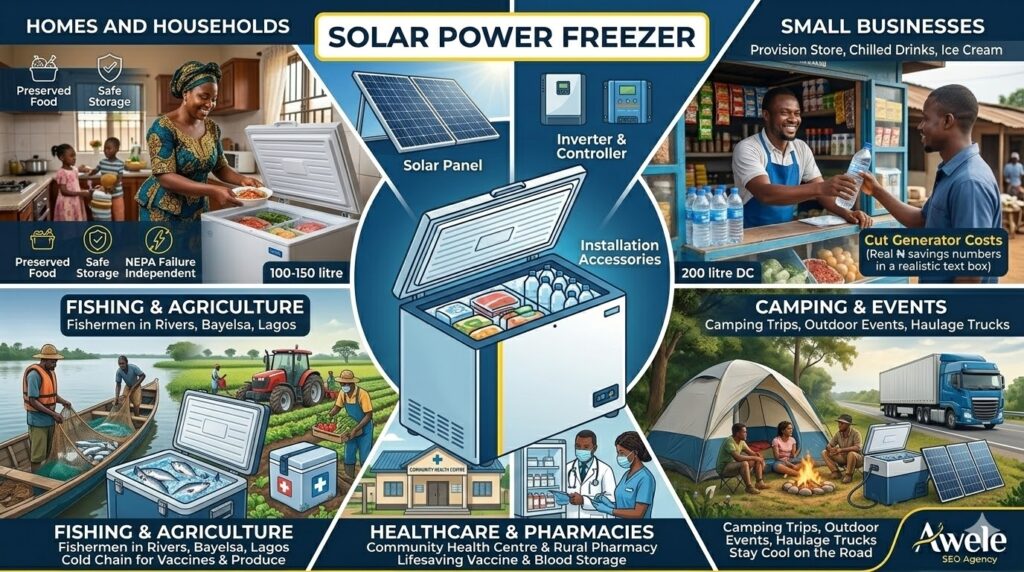
Solar freezers are not just for homes. They can be used in different ways and places.
Homes and Households
For the average Nigerian family, a solar freezer means preserved food, safe breast milk storage, reliable ice, and independence from NEPA failures.
A 100 to 150 litre unit is usually sufficient for a family of four.
Small Businesses and Shops
Provision store owners, chilled drinks sellers, ice cream vendors, and pepper soup spot operators across Nigeria can use solar freezers to preserve their perishable products despite the frequent power outages.
A 200-litre DC solar power freezer can save ₦30,000 to ₦60,000 per month in petrol costs.
Fishing and Agriculture
Fishermen in Rivers, Bayelsa, and Lagos use portable or chest solar powered freezers on boats and in remote landings to preserve fish.
Farmers can store vaccines, seeds, and perishable produce using solar fridges.
Healthcare and Pharmacies
Community health centres and rural pharmacies can rely on solar freezers to store vaccines, insulin, and blood products.
This is literally life-saving in areas without stable grid power.
Camping and Events
You can also use a portable 12V solar power fridge for a camping trip, outdoor event, or long road trips to keep your drinks cold.
How does a solar freezer work?
Understanding the basics helps you make better buying decisions and avoid being misled by sellers.
When sunlight touches the solar panels, energy passes to a charge controller that regulates it and safely stores it in the battery so it does not get damaged.
The battery sends the stored power to the freezer either directly if it is a DC freezer, or through an inverter that changes it to AC (the type of electricity a regular freezer understands).
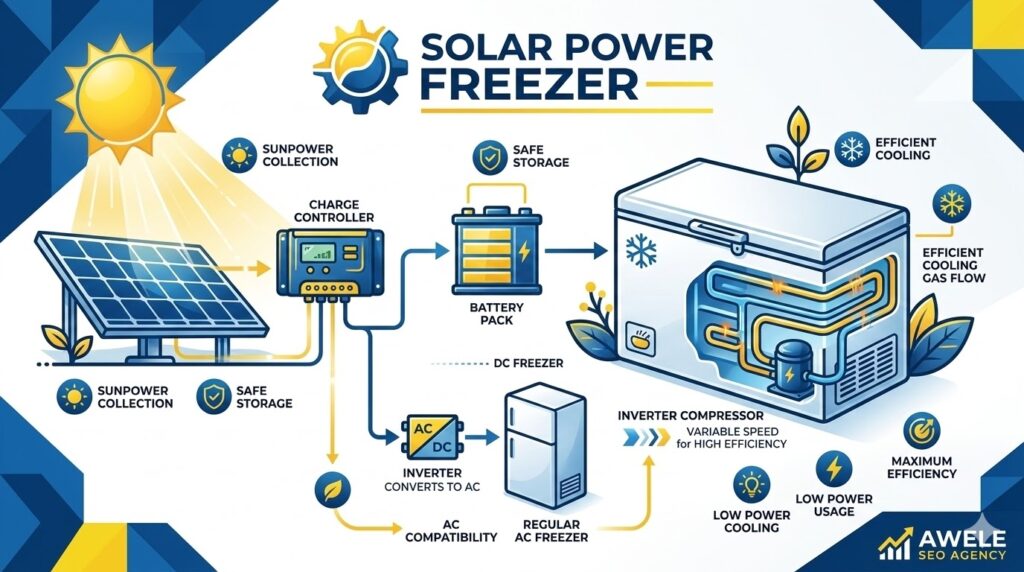
Now, the compressor inside the solar power freezer will start working by moving a cooling gas around the system to remove heat from inside the freezer and push it outside, keeping your food frozen.
You can also adjust the cooling of most modern solar power freezers that use inverter compressors. All you need to do is adjust their speed depending on how much cooling is needed; they use less power and work more efficiently than older freezers that run at one fixed speed all the time.
What are the components of a solar freezer?
A solar freezer works because of a few key components that work together to keep your food frozen even when there is no electricity.
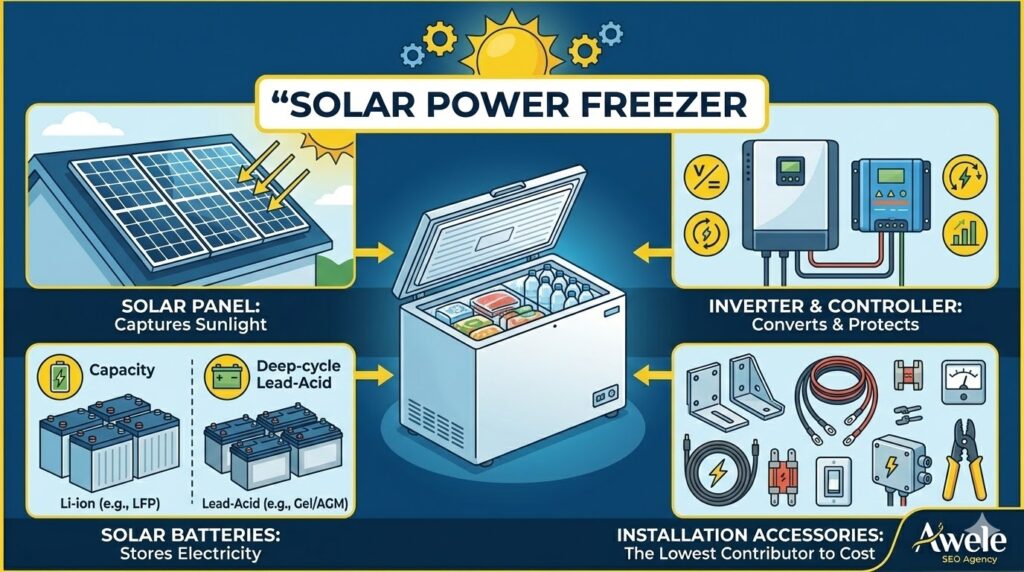
Solar Panels
The solar panel is the most important part of a solar power freezer; it captures sunlight and turns it into electricity. There are different types of solar panels.
Solar batteries
The electricity from the panels is stored in solar batteries.
Solar inverter and charge controller
The solar inverter is another crucial part of solar power freezers, because it changes the stored battery power into electricity that the freezer can use, especially for AC compressors.
A charge controller protects the battery by regulating the voltage and current from the panels so the battery does not get overcharged or damaged.
Solar power freezer installation accessories
This is the lowest contributor to the total solar power cost. They are accessories like,
- Mounting brackets for the panels,
- Wiring
- Fuses and switches,
They may seem small, but they are essential to keep the system safe, organised, and working efficiently, and choosing good-quality accessories helps prevent breakdowns and keeps your solar freezer running smoothly for years.
How can I choose the right solar powered freezer in Nigeria?
The 6-step process to follow when buying a solar power freezer, are as follows;
Step 1: Determine Your Cooling Capacity Needs
Start by calculating how much storage space you actually need. Think about what you’ll be freezing: fish, meat, vaccines, or packaged goods and how much volume that requires.
Freezers are measured in litres, and for most small Nigerian businesses, a 100–200L chest freezer is a practical starting point. Households typically need 50 to 100L.
Step 2: Pick the right type of Solar Freezer
DC-powered freezers (which run directly off solar panels and batteries) and AC-powered freezers (which need an inverter to convert battery energy to AC electricity).
DC freezers are generally more energy-efficient and better suited to off-grid (Nepa) Nigerian homes and small businesses.
AC models work better where grid power (Nepa light) occasionally supplements your solar system.
Step 3: Compare Brands and After-Sales Support
Before purchasing, find out whether spare parts and technicians familiar with the brand are available in your city or state.
A cheaper freezer with no local service support can quickly become an expensive problem.
Step 4: Calculate the Total Cost of Ownership
Don’t just compare purchase prices. Factor in the cost of the solar panels, battery bank, charge controller, and installation alongside the freezer itself.
A complete off-grid solar freezer setup in Nigeria typically ranges from ₦350,000 to ₦1,500,000+, depending on capacity.
Spreading this analysis over 5–10 years of expected use helps you see the true value.
Step 5: Verify Warranty and Build Quality
Look for a minimum 1-year compressor warranty, ideally 2–3 years. Chest freezers generally outperform upright models in hot climates because cold air doesn’t escape when the lid is opened.
Inspect the insulation thickness; thicker walls mean better temperature retention during power gaps.
Step 6: Buy from a Reputable Dealer
Purchase from authorised dealers or verified vendors on platforms like Jumia, Konga, or established electrical shops.
Confirm you will receive an official receipt, and test the unit before full payment if buying in person.
Avoid “tokunbo” (used) solar freezers unless you can verify the compressor’s condition.
Where can one buy a solar-powered freezer?
Online stores: There are trusted websites where you can buy solar powered freezer in Nigeria
Local markets: These are big physical markets in Nigeria where you can find different solar panel vendors. It is advisable to go with your solar power system installer to ensure you get the right solar panels for your system.
- Alaba International Market, Lagos
- Computer Village
- Oshodi Market
- Tejuosho Market
- Wuse 2 market(Abuja)
Frequently Asked Questions
Yes, absolutely. Solar panels generate DC electricity through a battery bank, an inverter, or directly from a DC model and can power a freezer continuously. In Nigeria’s sunny climate, a properly sized solar system can run a freezer 24 hours a day, 7 days a week with no grid input at all.
Yes. You do not need a single giant panel. Most freezer systems use 1–3 panels of 100W–300W each. For example, a 200-litre DC solar freezer typically works well with two 200W monocrystalline panels and a 200Ah LiFePO4 battery. The key is correct sizing by a qualified solar installer.
Yes, solar-freezers are widely available in Nigeria. Brands such as Haier Thermocool, Icecasa, Hisense, Sundanzer, and Snowsea sell solar-compatible and DC solar-freezers in Lagos, Abuja, Port Harcourt, Kano, and other major cities, as well as online through Jumia and Konga.
Yes, there are Purpose-built solar-powered (DC) freezers that exist and are more efficient than standard freezers adapted to solar systems. They use low-power compressors specifically designed to work with 12V or 24V battery banks, making them ideal for off-grid locations.
Yes, you can, and many Nigerians already do. The key is matching your system correctly: enough panels to charge the battery during the day, enough battery capacity to run the freezer overnight, and a freezer with a low enough wattage rating that the system can sustain it. A solar professional can help you size this correctly for your specific model.
Conclusion
It is time to stop letting your food spoil, even when the grid supply remains unreliable, and petrol prices continue to rise. Buy a solar powered freezer to preserve your food and perishables.
With you already understanding the price of solar freezers in Nigeria, follow the steps above to buy a quality solar freezer that will preserve your food and perishables.
